There's something about a play's
character crying to God for forgiveness that makes me veer between
two thoughts. One, the distant 'At least I'll never be like that',
the other, a humbler, and perhaps more realistic 'There but for the
grace of God go I'. Of course, it's the second of those two that the
original performers of this play were after; the audience is supposed
to recognise their own fragile state of grace, their own dependence
on divine mercy, and to repent sharp-ish before their fate catches up
with them.

The title alone should give it away.
Everyman. That character crying out to God, to mercy, to
charity and to all the things he's held dear through his life? That's
Everyman, and he represents, yep, you've guessed it, every one of us
(in this production, he's played by three people, including one
woman). We are each as guilty as him of the faults he admits by the
play's end – it's the usual: greed, lust, anger, gluttony, sloth.
Though we aren't quite complicit in
Everyman's sins, we (and I mean the play's immediate audience, rather
than mankind as a whole) are drawn into his repentance all the same.
He stands barely metres in front of us, asking that he be forgiven,
asking who he can turn to, and it's that insistent questioning that
raises questions for the audience. Questions like: what would I do if
called to give an account to God? Of course, you might not be too
worried, if your opinion of an afterlife is that it's non-existent,
but just go with it for a minute. There's a value to questioning the
balance and account of your life when near its end, even if you don't
believe that anyone supernatural's going to check up on you in your
grave. Everyman is especially concerned about the balance of Good
Deeds in his own account, and finding the book empty (like he does)
should be a cause of concern even for a hardened atheist.
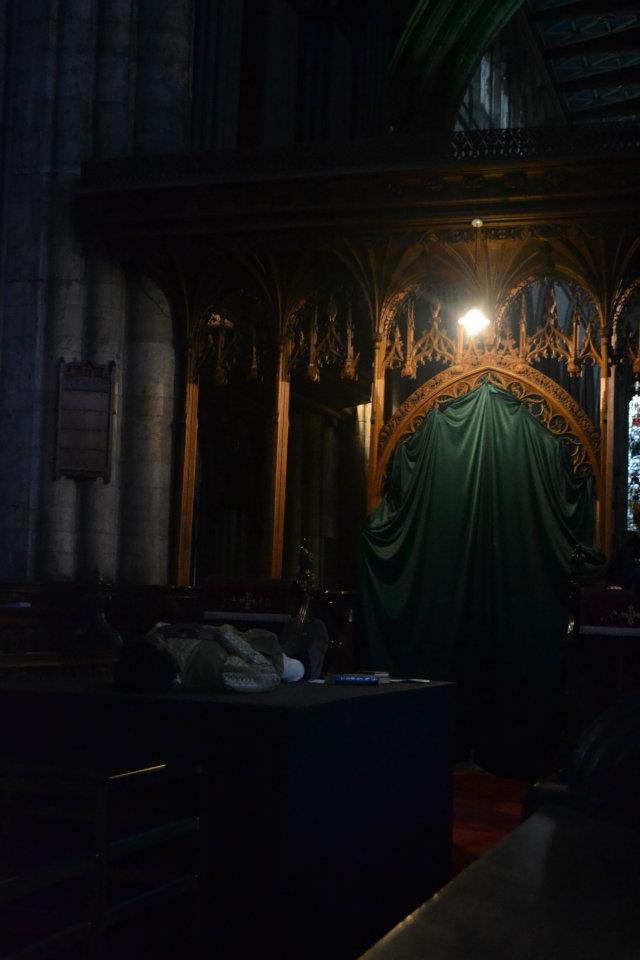 |
| Good Deeds (Mondé Sibisi) sleeps until Everyman repents |
But Everyman is hardly aimed at atheists; it's aimed at Catholic believers, reminding them that they're going to be checked up on on death, and they'd best keep their house in order. So of course, it makes perfect sense to stage Everyman in the Minster, in God's house; here is the perfection of God, aspire to it, everyone. And the church is perfectly suited to being a performance space – what is the church mass if not an elaborate performance by actors before an audience? - with the acoustics and (mostly natural) lighting to rival many more modern theatres. Religious ceremony is the birthplace of theatre, the elaborate and stylised address to the masses, the faintly poeticised and increasingly stage-y message preached to an audience sitting in hushed rows.
The University of Hull Drama Department's production immerses its audience in Hull's Holy Trinity Church (increasingly being opened up as a venue these days), where the architecture serves to hammer home the message of
obedience to the divine will and serves as a reminder of both God's
majesty and God's grace. We follow the story through the church on
foot, taken to four different stations along Everyman's journey from
frail sinner to reconstructed penitent. As Everyman hovers close to
death, we walk – fittingly, perhaps, gingerly, certainly – over
the graves of past generations, the inscriptions and memorials a
fixed and literal reminder of the the transitory nature of human
life. Again, the church's architecture reinforcing the message Death
has already given to Everyman: Life was but lent thee:/ for as soon
as thou art go,/ Another a while shall have it and then go therefro.
 |
| Jack Fielding's Everyman is left with no doubt about the message from Death (Johnny Neaves) |
The University Drama Department – and
specifically Dr Philip Crispin – has produced this living
examination of medieval drama, following on from Mankind in 2010. Mankind was declamatory, static (literally and
figuratively) and in a theatre. This is a much more immersive,
flowing piece. A series of strong individual performances give life
to a poetic depiction of human life close to the brink of death –
the great unknown, guidance on which can be found in the Bible and,
of course, this morality play.
Images thanks to Elizabeth Coombs Photography.
Images thanks to Elizabeth Coombs Photography.

