Showing posts with label the Bible. Show all posts

Saturday, 28 April 2012

Everyman at Hull's Holy Trinity Church


There's something about a play's character crying to God for forgiveness that makes me veer between two thoughts. One, the distant 'At least I'll never be like that', the other, a humbler, and perhaps more realistic 'There but for the grace of God go I'. Of course, it's the second of those two that the original performers of this play were after; the audience is supposed to recognise their own fragile state of grace, their own dependence on divine mercy, and to repent sharp-ish before their fate catches up with them.

The title alone should give it away. Everyman. That character crying out to God, to mercy, to charity and to all the things he's held dear through his life? That's Everyman, and he represents, yep, you've guessed it, every one of us (in this production, he's played by three people, including one woman). We are each as guilty as him of the faults he admits by the play's end – it's the usual: greed, lust, anger, gluttony, sloth.

Though we aren't quite complicit in Everyman's sins, we (and I mean the play's immediate audience, rather than mankind as a whole) are drawn into his repentance all the same. He stands barely metres in front of us, asking that he be forgiven, asking who he can turn to, and it's that insistent questioning that raises questions for the audience. Questions like: what would I do if called to give an account to God? Of course, you might not be too worried, if your opinion of an afterlife is that it's non-existent, but just go with it for a minute. There's a value to questioning the balance and account of your life when near its end, even if you don't believe that anyone supernatural's going to check up on you in your grave. Everyman is especially concerned about the balance of Good Deeds in his own account, and finding the book empty (like he does) should be a cause of concern even for a hardened atheist.
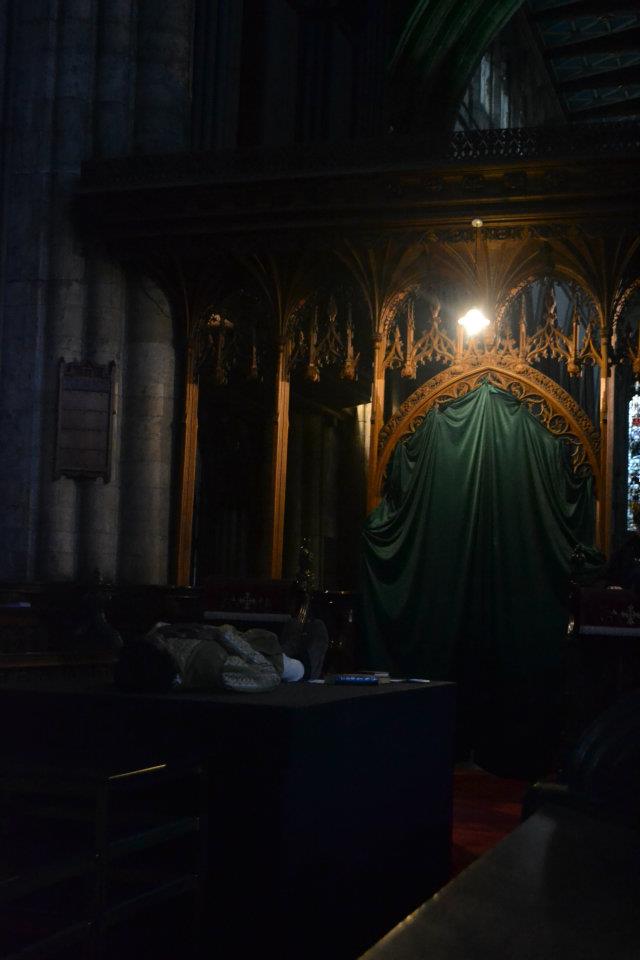
Good Deeds (Mondé Sibisi) sleeps until Everyman repents

But Everyman is hardly aimed at atheists; it's aimed at Catholic believers, reminding them that they're going to be checked up on on death, and they'd best keep their house in order. So of course, it makes perfect sense to stage Everyman in the Minster, in God's house; here is the perfection of God, aspire to it, everyone. And the church is perfectly suited to being a performance space – what is the church mass if not an elaborate performance by actors before an audience? - with the acoustics and (mostly natural) lighting to rival many more modern theatres. Religious ceremony is the birthplace of theatre, the elaborate and stylised address to the masses, the faintly poeticised and increasingly stage-y message preached to an audience sitting in hushed rows.

The University of Hull Drama Department's production immerses its audience in Hull's Holy Trinity Church (increasingly being opened up as a venue these days), where the architecture serves to hammer home the message of obedience to the divine will and serves as a reminder of both God's majesty and God's grace. We follow the story through the church on foot, taken to four different stations along Everyman's journey from frail sinner to reconstructed penitent. As Everyman hovers close to death, we walk – fittingly, perhaps, gingerly, certainly – over the graves of past generations, the inscriptions and memorials a fixed and literal reminder of the the transitory nature of human life. Again, the church's architecture reinforcing the message Death has already given to Everyman: Life was but lent thee:/ for as soon as thou art go,/ Another a while shall have it and then go therefro.

Jack Fielding's Everyman is left with no doubt about the message from Death (Johnny Neaves)

The University Drama Department – and specifically Dr Philip Crispin – has produced this living examination of medieval drama, following on from Mankind in 2010. Mankind was declamatory, static (literally and figuratively) and in a theatre. This is a much more immersive, flowing piece. A series of strong individual performances give life to a poetic depiction of human life close to the brink of death – the great unknown, guidance on which can be found in the Bible and, of course, this morality play.

Images thanks to Elizabeth Coombs Photography.

Sunday, 19 September 2010

The Catholic Church is missing a trick

Before and during his state visit to Britain Pope Benedict XVI – as you probably noticed – was under a lot of criticism. While the media focused on the historic ties being reconnected between the Vatican and Lambeth Palace, non-media voices tended to focus on the negative side of the current Pope, his Church and religion as a whole. But most of the recent criticism concern the sex abuse scandal which implicates his Holiness in official cover-ups. While that is undeniably A Bad Thing, it's only the most recent issue to cause problems for the Papacy.

What really irked me during Pope Benedict's speech at Westminster was his assertion that democracy and reason were under threat because secular societies no longer underpinned those values with the moral code of religion (ie. Catholicism). This coming from the man considered infallible by himself and his followers (no room for reasoning that one out, nor even any need to think about it), who not long ago banned any discussion in his worldwide Church on the subject of female ordination. So, no chance to think or argue about that either. The reason women can't be Catholic priests is tied into that moral code of religion that Pope Benedict insists should underpin reason and democracy. I for one can't see the logical reasoning behind (not even a discussion on) prohibiting female ordination.

Thing is, I've seen enough women leaders (both in churches and the secular world) to know that they can do just as good a job as men. In the pastoral role required of priests, they're often better than men – it's the maternal instinct. In fact, lads of the Catholic clergy, women are – whisper it – actually good at stuff sometimes. I know, I know, hard to believe. A quick look back through English history (not worldwide, nor Catholic, admittedly) shows that the periods commonly regarded as golden ages were presided over by women: Queens Elizabeth I and Victoria come to mind...it's probably too early to pass comment on the current Queen Elizabeth and the jury's still out on Thatcher, I know.

The Catholic Church is really missing a trick in not allowing women into the priesthood. I say this partly as a result of watching Peter Tatchell's The Trouble with the Pope on Channel 4, in which the one person Tatchell found to defend the Church and its policies was a woman. Fiona O'Reilly is an eloquent and non-judgemental defender of the Church (despite Tatchell's repeated efforts to trip her into calling him an evil person because he's gay), and her defence would have carried more weight had the Church taken her seriously (she clearly takes the Church and her faith seriously) and given her a dog collar. From what Tatchell says on Channel 4's website, O'Reilly sounds like she was put up by the Church as a low-level minion willing to parrot the Church's teachings without dragging the (male) hierarchy into a documentary they had no desire to be involved with. Most disappointing was that Tatchell didn't ask her about female ordination, because he was too wrapped up in the Church's apparent homophobia (though there were plenty of other disappointments in Tatchell's documentary).

As some of the strongest advocates for faith, healing and understanding, women deserve a place in the Vatican's priesthood – and should certainly not be denied ordination merely on the basis of gender. But now I'm just tripping out old feminist arguments. My point is that the Church is backward-looking and conservative on so many issues as to be radically out of step with the secular world. Its attitude to women is one major part of this; how can the Church hope to maintain its followers, or even expand, when it subjects half of the world's population to an inferior status? I don't ask the Church to change its opinion on homosexuality (not just yet) or contraception (not just yet), but the attitude to women – God's children as much as men, and surely able to hear God's word as much as men (the Virgin Mary comes to mind) – has to be re-examined.

Photo of the Vatican by Diliff.

Is it time for a new Pope?

His Holiness Pope Benedict XVINot all that long ago, the Pope was a widely-respected and much-loved leader of the world's billion or so Catholics as well as the Vatican City's head of state. His word carried a certain moral and ethical authority even for non-Catholics. What went so badly wrong?

Well, all of that was Pope John Paul II, the Polish Pope known for his warm public receptions and charismatic appearances. His successor, Pope Benedict XVI, is a German with a far colder public image, positively lacking in charm or charisma. Worse, he brings the reputation of 'God's Rottweiler' to the role, from his time as Cardinal Ratzinger and has gradually undermined that moral and ethical authority carried by the title Bishop of Rome.

Without wanting to understate the conservatism of John Paul II's papacy, Pope Benedict's conservative direction is one of the principle damaging factors in the Catholic Church's recent history. Yes, the sex abuse scandal is serious and damaging, but it is one in a series of incidents that show this conservative trend to be distancing the Church from the people. The scandal's personal implications for the man at the top – Ratzinger being the Cardinal blamed for earlier alleged cover-ups – tarnish the Papacy itself and the entire Church by implication. Worse, the conservative thinking of the current Papacy – in danger of taking the Bible literally – is out of touch with the secular society Pope Benedict is concerned to re-establish religion within; the two are incompatible.

That incompatibility is down to the Church's inability to move with the times. Secular society has advanced into the modern age, but the conservatism of Pope Benedict holds the Church back, restraining it in the race of human progress. This is the Church that refuses to even discuss the possibility of ordaining women because there are no female preachers in the Bible. It's funny, there's no electricity in the Bible but I don't hear of many priests refusing to have their churches re-wired.

His Holiness Pope John Paul IIBut the Bible was written (if you take a non-Christian or cynical view) by men in a patriarchal society roughly two thousand years ago. If you take a Christian, theistic view, it was written by God, via men in a patriarchal society roughly two thousand years ago to be read by that same patriarchal society. Of course there are no women preachers!

The worldwide church (not just the Catholic one) does a great deal of good in the world, as do other organisations in the name of their faith. So let's not go lambasting religion and arguing that anyone willing to listen to the Pope is somehow evil or misinformed. Religion has the power to help as well as harm – it's much more about how people interpret it – and I'm not for one minute arguing that religion is necessarily a bad thing. I just question whether Joseph Ratzinger is the best man to be leading the Catholic Church right now. Someone so embroiled in the biggest scandal the Church has faced in living memory, and generating such opposition in other areas is perhaps not the best spokesperson for the world's billion or so Catholics.

The Catholic Church needs to accept that the march of history has advanced, and they have to adapt or get left behind in their medieval theology. The Church is still stuck in the past, and that, your Holiness, is why secular society has marginalised religion.